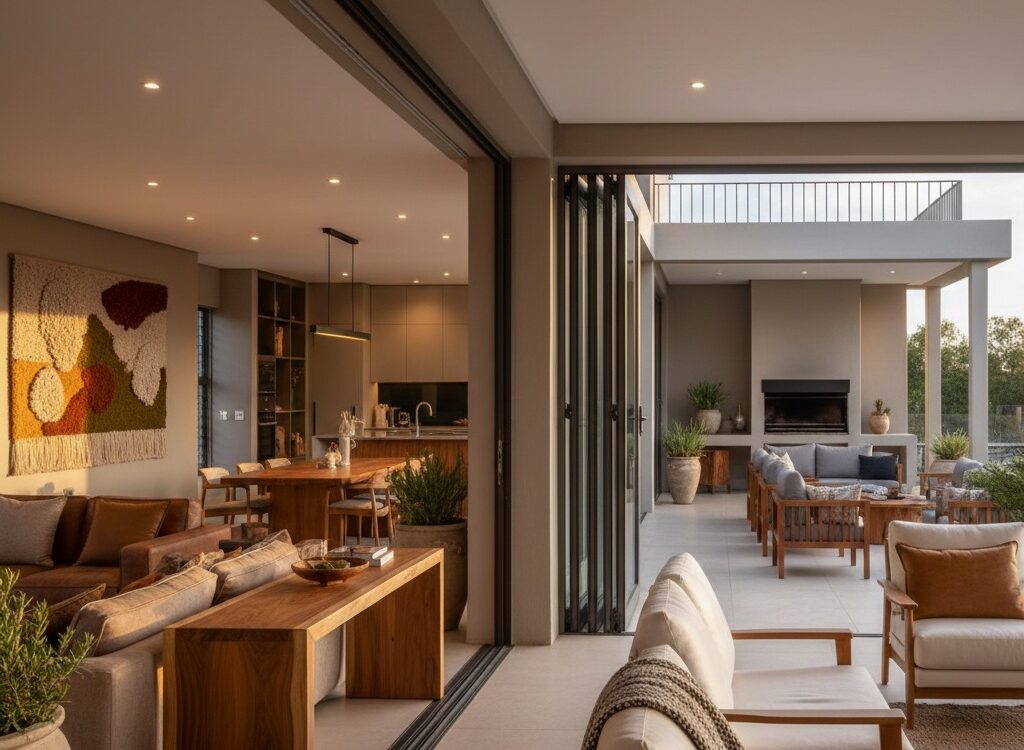
You’ve spent your weekends browsing showrooms from Sandton to Kramerville. You’ve invested in the solid timber dining table and the top-tier leather suite for the lounge. Yet, when you walk through your front door after a long commute, that elusive “wow factor” is still missing.
Instead of a sanctuary, your home feels like a collection of expensive things that happen to be in the same room. If you are a high-achieving professional, you are likely facing the Designer Gap. This is the space between owning premium items and inhabiting a finished home.
The Myth of the Shopping Spree
In South Africa’s premier estates and clusters, there is a common misconception that design is a series of transactions. We assume that if we buy the best pieces, the room will eventually complete itself.
However, a shopping spree is not a strategy. You can have a showroom-quality sofa, but if the space planning is off, the room will still feel cluttered or cold. In many South African homes, we also face the “Security-First” hurdle. We have heavy shutters and burglar bars that can make a room feel closed in. Buying more furniture will not fix that. In fact, it often makes the room feel even more like a cage rather than a retreat.
Why Money Cannot Buy “Flow”
“Flow” is the invisible thread that connects your kitchen, lounge, and stoep. It is what makes a home feel cohesive during a Saturday afternoon braai.
-
The Lighting Trap: Many premium homes rely on electric mood lighting. With the reality of loadshedding, a room that does not utilize natural light and reflective surfaces becomes a dark void the moment the grid goes down.
-
The Scale Misstep: A massive table might look grand in a warehouse, but if it chokes the movement to your patio, it creates friction instead of luxury.
-
The Lack of Soul: High-end furniture can often feel “catalogue-cold.” Without a strategy to integrate locally handcrafted textures, the space remains an unfinished project.
Real luxury is not about how much you spent. It is about the Furniture Cost-Per-Year (Replacement Tax) and investing in pieces that serve a functional “flow” rather than just filling a footprint.
The Local Story: Mark from Waterfall Estate
Mark is a busy tech executive who recently moved into a beautiful new cluster in Waterfall. He had the budget and the taste. He filled his home with imported pieces and high-gloss finishes. On paper, it was perfect. In reality, he hated spending time there.
His “Designer Gap” was the transition between his lounge and his stoep. The furniture was beautiful but too bulky, making the walk to the braai area feel like an obstacle course. Because he had not considered Simple Space Planning, the home felt like a series of disconnected showrooms.
We worked with Mark to move away from “buying mode” and into “logic mode.” By swapping one heavy piece for a locally handcrafted timber console and repositioning his seating to embrace the natural light, the home finally felt finished. It became the sanctuary he needed to escape the stress of the city
The “Aha!” Moment: Strategy Over Shopping
The realization for most time-poor professionals is simple but profound:
“I do not need to shop more; I need a strategy to finish this.”
When you stop viewing your home as a shopping list and start viewing it through the Inside Out Method, the pressure to buy disappears. You realize that a finished home is the result of intentional planning and a deep understanding of how you actually live. It is about the morning coffee in the kitchen and the late-night glass of wine on the stoep.
At Venice Living, we do not just provide furniture. We provide the bridge across the Designer Gap.