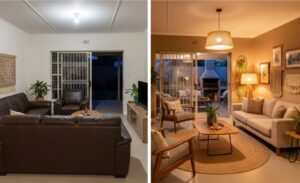
You walk into a furniture showroom and there it is: the perfect lounge suite. Sofa, loveseat, and armchair, all in matching fabric and style. It looks so elegant and complete. You buy the whole set, bring it home to your cluster or estate, and then the disappointment sets in. Your room feels crammed. Instead of a spacious sanctuary, it feels like a display floor.
You are not alone. This is the classic dilemma of the Retail Victim. It is the belief that matching sets simplify design, when in fact, they often create a Designer Gap that suffocates your space. This is often why a house full of premium furniture can still feel like an unfinished project.
The Sterility of Matching
Showrooms are designed to sell individual pieces, not to create a living home. When you replicate a showroom set, you inadvertently bring that commercial sterility into your private space.
-
Lacking Personality: Your home should reflect your unique story, not a catalogue page. Matching sets often lack the layers and curated feel that make a space truly personal. They fail to integrate locally handcrafted touches or legacy pieces.
-
Visual Monotony: A room filled with identical items creates a flat, uninspired aesthetic. There is no visual interest or interplay of textures, which is why great taste isn’t enough to make a room feel finished.
-
The Illusion of Completeness: A matching set might seem like an easy solution, but it often leads to a sense of dissatisfaction. It feels “done,” but not “right.”
How Sets Kill Walking Paths and Flow
Beyond aesthetics, matching sets can severely impact the functionality of your home, especially regarding the “Great Indoors” lifestyle.
-
Obstructed Pathways: A full matching suite often forces you to position furniture in ways that block natural walking paths between your lounge, kitchen, and stoep. This is often why your living room feels cluttered.
-
Disproportionate Scale: Showroom pieces are designed for vast open spaces. Bringing a large matching set into an average-sized room can overwhelm the area, making it feel smaller. This is especially problematic when factoring in “Security-First” designs, where heavy doors and bars already require careful space management.
-
The Replacement Cycle: Many showroom sets are “safe” choices that lack longevity. This leads to the hidden cost of safe choices where your room feels dated within twenty-four months.
The Local Story: Sipho from a Pretoria Estate
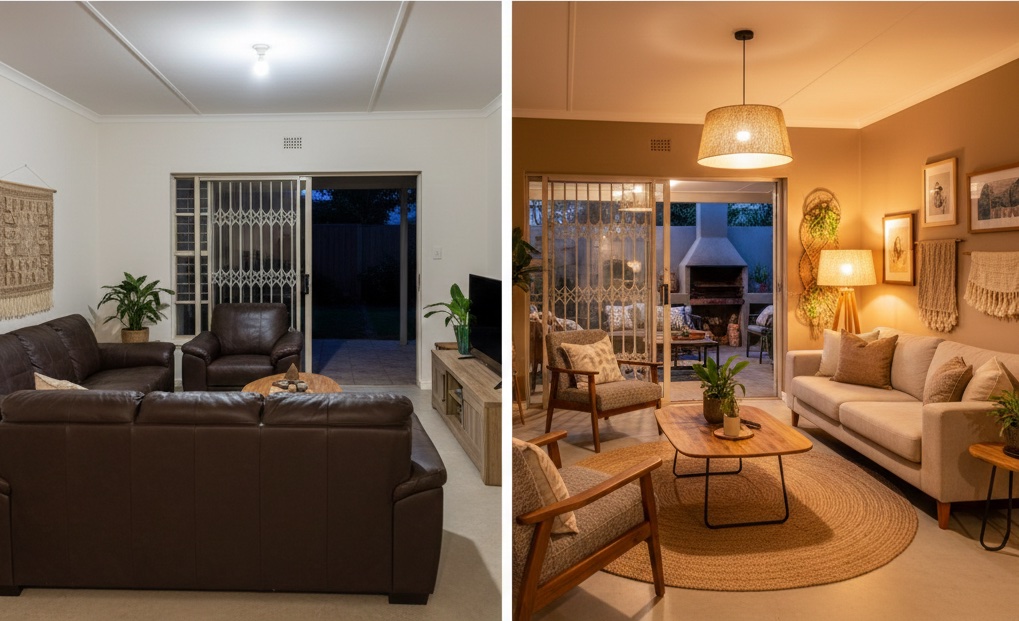
Sipho, a successful entrepreneur in a Pretoria estate, bought an expansive, dark leather matching lounge suite for his open-plan living area. He thought it conveyed sophistication. However, the massive sofas created a visual barrier, making the journey from the kitchen to the stoep feel awkward. The room always felt heavy and almost claustrophobic despite its size.
His “Designer Gap” was assuming that more furniture equated to a well-designed space. By rethinking his approach, he learned that your home needs less furniture, not more. He broke up the heavy sofa arrangement and introduced a lighter, locally handcrafted timber coffee table. The result was a lighter, more inviting lounge that seamlessly connected to his outdoor braai area.
The “Aha!” Moment: Beyond the Showroom Floor
The powerful realisation for the Retail Victim is often this:
“My house feels like a store because I bought it like a store.”
This shift in perspective is liberating. It moves you away from buying pre-packaged solutions and towards a thoughtful, strategic approach. Instead of simply filling space, you begin to curate it. This process respects your home’s unique architecture and your family’s lifestyle.
Stop gambling with your home comfort by relying on showroom floor layouts. When you look past the price tag, you see the real cost of cheap furniture and the value of a curated, mixed-element home.